Florida homeowners were forced into a new
insurance company. Whistleblowers say it siphoned millions in
profits.
As Florida moves homeowners’
policies out of its state-run insurer of last resort, insiders
question one new company’s finances. |
|
Article Courtesy of CBS News Investigations
By Scott Pham, Joe Enoch and Ash-har Quraishi
Published March 26, 2026
|
|
When golf-ball-sized hail and 60 mph winds slammed
the east coast of Florida in May, Chris Jadin came home to a truck
covered in dents and glass all over the floor of his house, his skylight
shattered by the falling ice. He would soon find out that the damage was
even worse: he would need to replace the entire roof of his house, and
soon, because hurricane season was less than a month away.
|
Like hundreds of thousands of homeowners
in Florida, his insurance company was Citizens, often dubbed
the “insurer of last resort” – a state-run option meant for
homeowners who can’t find coverage anywhere else. But when
he called Citizens, Jadin said he was surprised to hear that
it could no longer help him. Citizens had transferred his
policy to Trident Reciprocal Exchange, a brand-new insurance
company he had never heard of.
Jadin’s experience is part of a much larger push to
“depopulate” Citizens and push Florida homeowners into new,
often untested insurance companies. Sometimes, it happens
without them knowing and against their will. Consumer
advocates and industry critics say that some of these
companies are more interested in quick financial gains than
lasting protection and might be siphoning profits instead of
saving for future disasters.
CBS News has spoken with former
executives and other insiders familiar with Trident’s
operations who allege that the company is doing just that:
diverting millions of dollars in customers’ premium payments
to investors — dollars that are supposed to be used to pay
future claims. The whistleblowers say that this exposes the
company — and homeowners — to the risk of insolvency.
|
|
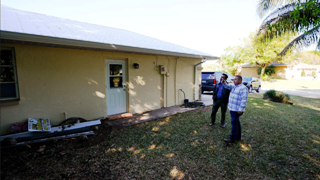
Chris Jadin shows CBS News correspondent Ash-har
Quraishi where hail wind damaged his home
|
Sources and internal documents reviewed by CBS News
describe a deal Trident struck with an investor-owned affiliate called
Triton Re that, according to Trident’s former chief financial officer,
would only serve to enrich investors at the expense of policyholders.
It's the continuation of a worrisome trend at the heart of Florida’s
insurance market — and a warning for homeowners nationwide.
Between 2021 and 2023 in Florida, nine property insurance companies went
insolvent, leaving their customers suddenly without protection in the
most hurricane-prone state in the country. The market dried up and
homeowners couldn’t find insurers willing to take their money. More than
800,000 people found themselves with no other option but the state-run
Citizens, which suddenly became the No. 1 market leader in Florida home
insurance.
California has been up against a similar crisis in recent years. When
State Farm said it would stop insuring in the state, it forced
homeowners onto the California FAIR plan, its state-backed option of
last resort.
When Florida’s local insurance companies began to fail, critics
suspected that their investors may have hastened their demise by taking
excess profits instead of shoring up surplus funds to prepare for
disasters, as experts say reputable insurance companies are supposed to
do. Early last year, the Tampa Bay Times unearthed a report from the
state’s insurance regulator that seemed to confirm many of those fears,
showing that while insurance companies were reporting losses to the
state, they paid high fees to less-regulated sister companies, which
raked in billions of dollars in profit.
Backed by extensive documentation reviewed by CBS News, the sources
claim that investors at Trident took control over the company from its
founder and spun up an affiliated business entity to drain the insurer
of money. The whistleblowers CBS News spoke with say that without those
funds, when a real disaster inevitably hits in the future, Trident may
not be able to protect the nearly 16,000 customers whose money they are
taking today.
When reached for comment, representatives from Trident disputed these
claims and said their affiliate transactions were legitimate and
industry standard.
“Sir, you must be mistaken”
When Jadin was told that Trident was his new insurer, he tried to roll
with the change.
He said he had never filed a claim with Citizens — or any insurance
company for that matter — so he didn’t know what to expect. At first,
his experience was smooth: Trident sent an adjuster, who confirmed he
needed a new roof and sent him an estimate of nearly $30,000. Jadin said
he knew a reputable roofer, who told him the estimate was reasonable, so
he signed a contract for the work and got started. He thought everything
was on track until he got a call from a different roofing company he’d
never heard of.
“I was like, ‘Sir, you must be mistaken. I have a roofer’,” Jadin said.
When he called Trident, they told him they were invoking their “right to
repair” — an insurance concept where the carrier may require a
policyholder to fix damage using the company’s preferred contractor
rather than cutting a check.
The switch was so new, Jadin didn’t even have a contract from Trident.
He was told that this shouldn’t matter because Trident had merely “taken
over” his Citizens policy and all the old terms should still apply. But
there was one problem: the words “right to repair” didn’t appear
anywhere in that older policy. Jadin read it over and over and he
concluded Trident was quoting policy language that didn’t appear to
exist.
“It was infuriating,” he said. “I mean, these people telling me that,
‘No, we're kind of screwing you over, and you kind of have to eat it,
and that's just the way it is’."
Finally, Jadin called a lawyer, who threatened to sue Trident. Before
the case ever went to trial, the company agreed to compensate Jadin the
amount they originally offered him in an estimate.
In the past, Trident may have had to cover Jadin’s legal bills, but
recent laws intended to protect insurers from lawsuits made that a lot
harder now. Jadin won his dispute but came out behind.
“They just did exactly what they were going to do in the first place,”
said Jadin. “But it cost me $3,000 to make them do that.”
The takeout engine
Over the past two years, Florida managed to get 17 new insurance
companies to enter the market. Most are doing business solely or
primarily in the Sunshine State. Since then, rates have begun to
decrease, albeit slowly, and homeowners have started to see options
other than Citizens for the first time in years. It’s a remarkable
turnaround that has been propelled by one powerful engine — the “takeout
program.”
After the insolvencies of 2021 and 2022, Citizens swelled to a peak of
1.4 million policies, representing a dangerous liability for the state,
and by extension, all of its policyholders.
That’s because Citizens hasn’t always been able to keep a surplus of
cash capable of paying millions of claims or anything close to it. In
the event of a large natural disaster, the state-run company can raise
needed funds by assessing fees on all insurance companies in the state,
who pass that charge directly to customers. Left unchecked, this can
lead to a downward spiral where insurance gets more expensive and less
profitable, more companies leave, insurance gets even harder to find for
customers, and the process repeats.
To "depopulate" Citizens, the state lets private insurers peruse the
policies, cherry-pick what they think are the best and safest homes, and
take over those contracts. It’s a distinct advantage for a new company.
It can quickly acquire customers without the usual costs like agent
commissions or marketing. Without spending a dollar on advertising, a
company like Trident can go from nothing to $100 million in revenue in
18 months.
These changes have helped usher in new options for customers, but
consumer advocates worry that it might attract companies more interested
in easy profits than long-term solutions.
“It becomes a form of corporate welfare,” said Doug Quinn, a consumer
advocate who runs the Coalition Against Insurance Fraud. “You'll see a
lot of these undercapitalized companies coming in specifically for
takeouts.”
Recent legislation has made the takeout program even better for
insurance companies. Customers can now be removed from Citizens against
their will. If a takeout company offers them a policy that costs within
20% of their old bill — even if it’s higher — they have to take it.
“Either way,” said Quinn, “you’re going to be moving out of Citizens to
a company that may or may not be safe, that may or may not increase your
premiums dramatically in further renewals.”
A big pile of money
When Maria Moller started Trident in 2024, she said, fast profits were
not top of mind.
“The insurance business is a patient business and I’m a patient person,”
she told CBS News.
Originally from Colombia, Moller moved to Florida in the 1990s and built
a career around property insurance. She worked at all levels of the
business, from controller to compliance officer to chief financial
officer. By the time Florida companies were going bankrupt in record
numbers, she had amassed more than 25 years in the industry and was
ready to strike out on her own.
In 2024, she found investment capital through Chris Johnson, an
entrepreneur who had recently sold a successful fence-building business.
He had little experience in the insurance industry but was able to
gather about $25 million for the initial capital. Moller was to be CEO,
with Johnson as chairman of the board.
In less than a year, the company fired her.
Moller said that she and Johnson had intense disagreements about how to
handle its early revenue and whether to keep those takeout premiums
inside the company’s accounts where it could be used to pay claims.
The company had a North Carolina affiliate called Triton Re that was set
up as a reinsurer. Like insurance for insurance companies, reinsurers
take a fee or a cut of homeowners’ premiums in exchange for covering a
portion of losses from big disasters.
She said that Johnson pushed for a contract with Triton Re that would
cost Trident millions and provide little in return.
“All that does is to take money out of the exchange and goes to another
company for no benefit,” said Moller in an interview.
Florida insurance companies, which are exposed to huge risk, pay a lot
for reinsurance and must use the little that’s left to pay expenses and
build surplus reserves. These reserves of cash can often determine
whether a company survives or fails after a storm. In years without a
hurricane, there can be temptation by investors to take the money left
over after reinsurance as profit, according to Dan Tighe, an attorney
who represents claimants against insurance companies. Especially for
aggressive investors, he says, it’s hard to take the long view, which is
one reason why insurance is so highly regulated.
“They're sitting on a big pile of money that's supposed to stay there to
make sure, especially in a soft market, their reserves should be
growing,” said Tighe.
In Florida, state regulators limit insurer profits. For years, insurance
companies have looked for ways around those limits. One common move is
to run the business through an affiliated contractor owned by a holding
company. Called a “managing general agent,” the carrier essentially pays
itself large fees to run the business. If the fees are high enough, the
investors can extract profit that would otherwise be restricted at the
main, regulated insurance company.
Triton Re is not a management company. It’s a reinsurer. But
whistleblowers told CBS News they believe the arrangement served the
same purpose: moving money out of the insurer and into an affiliated
company under terms that left Trident with less money to build surplus
and pay future claims.
In written comments to CBS News, Johnson wrote that Moller’s termination
had nothing to do with Triton Re, but rather for “underperforming” and a
“self-dealing scheme where she enriched herself and her husband to the
tune of almost $400,000”. Johnson also said Moller fell far short of her
own projections, and that the board brought in a consultant to evaluate
the company's technology, which led to the discovery of Moller’s alleged
self-dealing scheme. Moller said she formally opposed the Triton Re
transaction in December 2024, along with the company's chief financial
officer.
The company had used FAScorp, Moller’s husband’s IT company, to set up
computers and networks for the fledgling startup. Immediately after
firing Moller, Johnson, through Trident’s holding company, sued her and
her husband’s company. The lawsuit claims Maria hired FASCorp “without
the knowledge or approval of Plaintiff’s board,” but Moller denies that,
saying that Johnson and the holding company were aware of the
arrangement from the start.
“FASCorp and my husband, Greg, were involved with the company from its
earliest stages, well before Trident became associated with Mr. Johnson
or his investors,” Moller said in a statement. “There was never anything
hidden about his role.”
She said Johnson’s account obscured the larger fight over Triton Re,
which she saw as a way to bleed money from Trident rather than
strengthen it. The two sides are now locked in arbitration over her
firing. Johnson said Trident prevailed on summary judgment; Moller
countered that the ruling was a partial award on a narrow legal issue
and that the case is ongoing. Moller has also sued Trident and its
executives, directly accusing them of mismanagement and regulatory
violations, including the Triton Re deal which the complaint calls the
“reinsurance scheme to convert revenues” from the insurer into the
control over Johnson and other investors.
Short gains
John Ter Louw, who joined the company as Chief Financial Officer shortly
after the deal with Triton Re was decided, said he never liked the
arrangement with the affiliate.
“I was not a huge fan of it,” he told CBS News.
The deal would leave Triton Re responsible for 50% of all claims, up to
certain limits. In return, the insurance company would pay Triton Re 50%
of its premiums over the course of the contract, which initially covered
roughly half a year. Such terms are not unusual and can help insurance
companies weather costly disasters. In this case, however, the contract
started late in the winter of 2024 at the very end of Florida’s
hurricane season, Ter Louw said.
The deal meant Trident was giving up half of its income when hurricane
season was already over.
“There was very little concern,” said Ter Louw. “I think it was like 11
or 12 days' worth of hurricane season and that was it.”
In an email to management, he wrote that the only reason for this deal
“was to remove profits from [Trident Reciprocal Exchange] and into other
entities.”
Internal documents show Johnson himself described the deal similarly. In
an email to Moller in December 2024, he wrote that the reinsurance deal
“has presented a far better opportunity than any of us realized for the
investors to make an extraordinary amount of money essentially risk
free.” Johnson later told CBS News that "risk free" was shorthand for
"hurricane-free," meaning the company had made it through hurricane
season without a catastrophic event. He said it was not an admission
that the contract lacked legitimate risk transfer.
All told, said Ter Louw, Trident sent more than $28 million in homeowner
premiums to Triton Re. Typically about a third is paid back to the main
insurance company in the form of commissions, which would leave at least
$18 million going out the door. In its latest financial filings, Trident
posted a loss of more than $1 million before fees and taxes.
In written comments, Johnson argued that it was Moller herself who
masterminded Triton Re and included it in some of the earliest pitch
documents. Moller said that while she advocated for the creation of an
affiliated reinsurance company, the structure that was ultimately put in
place was not her design and was not part of the Plan of Operation
approved by state regulators. She argued that despite his claim of no
operational involvement, Johnson personally pushed through the
profit-diverting contract over her objections.
“I was not there to make any short gains. I was not there to lend myself
to do transactions like this one,” she said. “I was trying to build an
insurance company that would have a long-term longevity. That’s what I
was looking for. But his objective and mine were very different. And
that’s the issue.”
The regulator’s role
CBS News spoke to multiple people with inside knowledge of Trident’s
operations. All alerted the state insurance regulator about their
observations. Moller wrote to the state Office of Insurance Regulation
as early as January 2025 while still employed as CEO.
While some sources told CBS News the OIR followed up with questions,
most say they are disappointed in the agency’s response and are waiting
for more concrete action. The regulator has far-reaching powers and
could do anything from fining the company to removing executives to
forcing a sale of the entire operation.
The stabilization of the insurance market has been a major point of
pride for Gov. Ron DeSantis, who in 2022 pushed through reforms making
it harder for customers to sue insurance companies or avoid having their
policies taken over from Citizens without their permission.
“We are seeing nothing but good news across all data points for
Florida’s auto and home insurance markets,” said Insurance Commissioner
Mike Yaworsky in a January press release touting lower rates for
Citizens policyholders. “These positive results are entirely related to
our historic tort reforms, driven largely by Governor DeSantis’
leadership."
“We will hold firm in our commitment not to go back to the broken
insurance market of the past,” said DeSantis in that same release.
Critics of the industry say that all this momentum might leave the
industry under-regulated. “There is a concern that maybe the regulators
are looking out for themselves more than they are for the consumers,”
said Quinn, the consumer advocate.
Still, there are signs that the state is beginning to scrutinize
Trident’s operations.
Internal documents reviewed by CBS News show that, in a recent audit,
Florida’s Office of Insurance Regulation took a look at Trident’s
contract with the affiliate Triton Re and didn’t like what it saw.
In a letter to the company’s chief operating officer, Eric Anderson,
auditors noted that the terms were so favorable to the reinsurer (and
unfavorable to Trident) that it was nearly impossible for the reinsurer
to lose money. The auditors said the agreement put so many restrictions
on how much Triton Re could pay back in the event of a claim, it would
take two hurricanes in a two-week period before the reinsurer would pay
more money than it took from Trident.
“It is unlikely the Company would experience two hurricane events in the
two remaining weeks of hurricane season,” the auditors noted.
Chris Johnson, chairman of Trident’s board, wrote that this kind of
reinsurance contract is “a commonly used vehicle by many carriers to
plug holes in their reinsurance program” but did not respond to specific
questions about the flow of money through Triton Re. He added that, as
an investor with no official operational role in the company, the Triton
contract was Moller’s “brainchild from day one and had nothing to do
with the investors.” Moller disputes that characterization, telling CBS
News that Johnson personally executed the agreement on behalf of Triton
Re.
The OIR would not comment on Triton Re specifically but wrote,
“Affiliate arrangements and associated fees are a standard practice
nationally and the OIR continues to advocate for—and exercise—the
highest level of scrutiny to ensure these arrangements are not used to
undermine the financial stability of Florida’s domestic market.” The
agency noted that Trident is currently undergoing routine financial
examinations which include a review of affiliate transactions. It said
that recent legislative changes gave the agency new statutory authority
to examine affiliates with the same rigor applied to primary insurers —
tools the agency said it did not previously have.
The regulator added that it was aware of disclosures made by Moller and
others and that they “have been subject to rigorous review.”
Florida’s boom and bust cycle
An article in the Sarasota Herald-Tribune begins: “A growing number of
homeowners get their insurance from tiny, untested companies that have a
few million dollars in the bank but insure billions worth of property
they could never hope to rebuild on their own. No one knows what will
happen when the next big storm strikes Florida shores. But the signs are
not promising.”
These words were not written in 2026, but in 2010 by Paige St. John, who
would go on to win the Pulitzer Prize for investigative reporting. After
16 years, five major hurricanes, and repeated efforts to stabilize the
market, these words now read less like history and more like a warning.
When St. John was writing, Florida insurance was in a now-familiar
crisis: legacy insurance carriers were leaving the state and homeowners
were forced into Citizens. Then, as now, the state worked to off-board
those Citizens customers onto new, small companies that were just
entering the market.
Many of the companies from that era went insolvent, leaving homeowners
once again scrambling for coverage in the wake of storms. The
whistleblowers who spoke to CBS News say Trident shows how that cycle
can begin again: a new company grows quickly from takeout policies and
shifts millions of dollars to affiliates, leaving the insurer itself
with less money to build surplus and pay future claims.
Customers like Chris Jadin did not choose to become part of this
experiment, but homeowners like him will bear the consequences if it
fails. The question now is whether Florida has finally repaired its
broken insurance market or once again built it on a foundation too weak
to withstand the next big storm.
|