|
Article Courtesy of News4Jax
By Tiffany Salameh
Published July 18, 2026
|
WATCH VIDEO |
|
JACKSONVILLE – A Jacksonville social media influencer says she’s being forced
out of the home her late father left her after a homeowners association in an
Oakleaf 55-and-older community sued to remove her from the neighborhood and
proposed charging residents a $155,000 special assessment to help pay legal
fees.
|
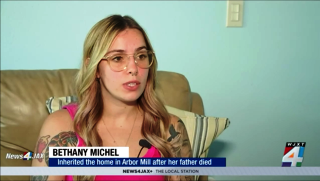
Bethany Michel, 28, inherited the home in
Arbor Mill after her father, a disabled veteran, died in
October 2023. Michel said she moved into the home in 2020 to
care for her terminally ill father during the COVID-19
pandemic after restrictions at his assisted living facility
made it difficult to provide his dialysis care.
Now, nearly three years into a legal dispute with the
homeowners association, Michel says the fight has become
about more than just where she lives.
“I 100% am being forced out,” Michel told News4JAX. “They’re
trying to rip my office away from me, too.”
Michel, who has built a large following
by posting restaurant reviews on social media, recently used
her platform to bring attention to the dispute before
homeowners voted on a proposed special assessment.
|
|
|
She said the HOA wants each of the community’s approximately 155 homeowners to
contribute about $1,000 toward legal costs associated with enforcing the
community’s age restrictions.
“I realized I had 48 hours before a special assessment was voted on,” Michel
said. “I just did what I know to do and I posted about it on social media.”
According to the community’s governing documents, every occupied home must
include at least one resident who is 55 or older. The declaration also prohibits
anyone under 19 from living in the community and allows the HOA board to grant
hardship exceptions at its discretion if the community remains compliant with
federal fair housing requirements. Homeowners are also required to notify the
association of changes in occupancy after events such as a death or inheritance.
The community’s declaration states the neighborhood is intended to comply with
the federal Housing for Older Persons Act, which allows qualifying communities
to restrict residency based on age if at least one occupant in each home is 55
or older and the community meets other federal requirements.
Michel argues her circumstances are unique.
She said the home’s builder was aware her father intended to leave the home to
her and assured the family she would be “grandfathered in” after his death. She
said she has never seen documentation confirming that arrangement.
“My dad’s biggest concern was something would happen to him,” Michel said. “His
dying wish was that this house would be left to his daughter.”
Less than three months after her father’s death, Michel said she received notice
reminding her she no longer met the community’s age requirements and was asked
to move.
The dispute has since evolved into litigation.
“Every upgrade we made, [my dad] said, ‘This is going to be for you one day,’”
Michel said. “It’s so sentimental. I sleep with the same pillow in the same bed
that he did every day.”
Michel said she has lost access to neighborhood amenities, including the pool,
gym and clubhouse, while the lawsuit continues. She also questions whether
homeowners on fixed incomes should be required to help finance the legal battle.
The case also raises broader questions for families who inherit homes in
age-restricted communities.
Although ownership of a home may transfer through inheritance, the community’s
governing documents make clear that ownership does not automatically grant the
right to occupy the property if age requirements are not met. The declaration
specifically states that owners under 55 may own property but cannot live there
unless the occupancy requirements are satisfied.
Michel said she hopes her case encourages other residents to think about what
happens when a homeowner dies.
“Everyone here is one day, one breath, one year away from that question,” she
said. “People need to think about what happens to their families.”
Neighbors could help pay legal costs
The legal dispute has now expanded beyond Michel.
Michel said many neighbors have told her they oppose paying for the lawsuit.
“I think people have a stronger desire not to pay $1,000 than they do for me to
leave,” she said.
Her next-door neighbor, Bob Stadler, agrees.
“I don’t think we should have to pay,” Stadler said. “I can’t afford $1,000, and
a lot of people around here are on a fixed income.”
Stadler said Michel has never caused problems in the neighborhood.
“I never know she’s even there,” he said. “If she wants to stay, let her stay.
If she wants to move, let her move. But don’t force her out.”
What the law says
Arbor Mill is governed as a 55-and-older community under the federal Housing for
Older Persons Act (HOPA).
The law requires at least 80% of occupied homes to have at least one resident
who is 55 or older. The remaining 20% provides flexibility for situations
involving younger spouses, caregivers or inherited homes. However, individual
homeowners associations may adopt stricter occupancy requirements through their
governing documents.
According to Arbor Mill’s recorded declaration, every occupied home must have at
least one resident who is 55 or older. While younger individuals may inherit
ownership of a home, ownership alone does not automatically grant the right to
live there if the occupancy requirements are not met.
Michel believes her case highlights an issue many families could eventually
face.
“For them to tell me to pick my life up and just get out because that’s what
they want, that’s not right,” she said.
News4JAX reached out to the Arbor Mill HOA and its management company for
comment on the lawsuit, the proposed special assessment and whether alternatives
had been considered. They declined to comment.
The HOA board is expected to consider the proposed special assessment during its
meeting Wednesday evening.
|