|
Article Courtesy of The Miami Herald
By Denise Hruby
Published December 24, 2024
|
Dozens of luxury
beachfront condos and hotels in Surfside, Bal Harbour, Miami
Beach and Sunny Isles are sinking into the ground at rates
that were “unexpected,” with nearly 70 percent of the
buildings in northern and central Sunny Isles affected,
research by the University of Miami found.
The study, published Friday night, identified a total of 35
buildings that have sunk by as much as three inches between
2016 and 2023, including the iconic Surf Club Towers and
Faena Hotel, the Porsche Design Tower, The Ritz-Carlton
Residences, Trump Tower III and Trump International Beach
Resorts. Together, the high rises accommodate tens of
thousands of residents and tourists. Some have more than 300
units, including penthouses that cost millions of dollars.
“Almost all the buildings at the coast itself, they’re
subsiding,” Falk Amelung, a geophysicist at the University
of Miami’s Rosenstiel School of Marine, Atmospheric and
Earth Science and the study’s senior author, told the Miami
Herald. “It’s a lot.”
Preliminary data also shows signs that some buildings along
the coasts of Broward and Palm Beach are sinking, too. |
|
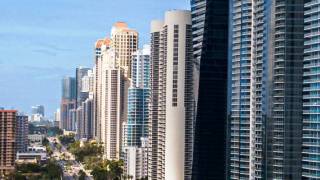
A new study by University of Miami researchers shows
a string of beachside high rises in Sunny Isles, the skyline shown
here, along with Bal Harbour, Surfside and Miami beach have been
sinking into the ground at unexpected rates.
|
|
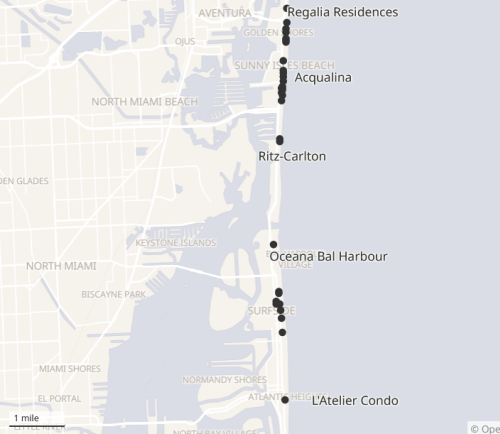
Sinking Condos in
Miami-Dade
A new University of Miami study found that these 35
high-rise towers in Miami-Dade were sinking several inches
into the ground between 2016-2023.
Experts called the study a “game changer” that raises a host
of questions about development on vulnerable barrier
islands. For starters, experts said, this could be a sign
that rising sea levels, caused by the continued emission of
greenhouse gases, is accelerating the erosion of the
limestone on which South Florida is built.
“It’s probably a much larger problem than we know,” Paul
Chinowsky, a professor of civil engineering at the
University of Colorado Boulder, told the Herald.
Initially, researchers looked at satellite images that can
measure fractions of an inch of subsidence to determine
whether the phenomenon had occurred leading up to the
collapse of Champlain Towers in Surfside, the 2021
catastrophe that killed 98 people and led to laws calling
for structural reviews of older condos across the state. The
researchers did not see any signs of settlement before the
collapse “indicating that settlement was not the cause of
collapse,” according to a statement. |
|
|
Instead, they saw subsidence at nearby
beachside buildings both north and south of it.
Surprising findings
“What was surprising is that it was there at all. So we
didn’t believe it at the beginning,” Amelung said,
explaining that his team checked several sources that
confirmed the initial data. “And then we thought, we have to
investigate it,” he said.
In total, they found subsidence ranging between roughly 0.8
and just over 3 inches, mostly in Sunny Isles Beach,
Surfside, and at two buildings in Miami Beach – the Faena
Hotel and L’atelier condo – and one in Bal Harbour.
It’s unclear what the implications are or whether the slow
sinking could lead to long-term damage, but several experts
told the Herald that the study raises questions that require
further research as well as a thorough on-site inspection.
|
“These findings raise
additional question which require further investigation,”
Gregor Eberli, a geoscience professor and co-author of the
study, which was published Friday in the journal Earth and
Space Science, said in a statement. Lead author Farzaneh
Aziz Zanjani pointed to the need for “ongoing monitoring and
a deeper understanding of the long-term implications for
these structures.”
Though the vast majority of affected buildings were
constructed years or decades before the satellite images
were taken, it is common for buildings to subside a handful
of inches during and shortly after construction — a natural
effect as the weight of the building compresses the soil
underneath.
And sinking doesn’t necessarily create structural issues.
“As long as it’s even, everything’s fine,” Chinowsky said,
placing his hands next to each other, “the problems start
when you start doing this,” he said, then moving one hand
down faster than the other.
But such uneven sinking, known as differential subsidence,
can cause significant damage to buildings, he said. “That’s
where you can get structural damage,” he said. More research
is needed to determine whether the buildings are sinking
evenly or not. |
|
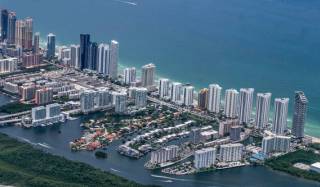
High-rise building dominate the skyline of the coast
of Miami-Dade County, from Sunny Isles Beach down to Miami Beach. A
new study by University of Miami researchers shows at least 35
buildings in the stretch have sunk by as much as three inches
between 2016 and 2023.
|
An uncertain impact
“Sometimes it can be dangerous, sometimes not – it will have
to be evaluated,” said Shimon Wdowinski, a geophysicist at
Florida International University, told the Herald. Wdowinski
worked on a different 2020 study that showed that the land
surrounding the Champlain Towers – not the buildings
themselves – had been subsiding back in the nineties, though
that alone couldn’t have led to the collapse. The National
Institute of Standards and Technology (NIST) has yet to
release a final report on the cause but a Herald
investigation pointed to design and construction flaws as
well as decades of maintenance issues.
|