For decades, the law
firm representing the collapsed Champlain Towers South has
waged a successful lobbying campaign against condominium
safety measures. Now, the Becker firm is at the center of
discussions about how to make condos safer.
The irony is not lost on those who’ve observed the 48-year
history of the Fort Lauderdale firm formerly known as Becker
& Poliakoff.
“A lot of stuff I tried to propose, the No. 1 group that
would fight me was Becker & Poliakoff,” said former state
Rep. Julio Robaina, R-Miami, who focused on condo legal
reforms when he served in the Legislature. “That was my
nemesis.”
The firm is a force in Tallahassee politics and in city
halls and condo towers across the state. Its founders are
credited with writing much of the law that underpins condo
living in Florida, and its principals have spent decades
constructing a hands-off regulatory framework that empowers
associations to steer their own fate.
The firm has marshalled its condo clientele to deliver
torrents of “grassroots” attacks on legislation that could
have made condos safer.
Closer to home, its attorneys have aggressively pursued unit
owners who challenge the boards Becker represents, in one
case demanding reimbursement for $120,000 in legal fees from
a Boca Raton condo owner who sued his association over a
$1,300 repair bill.
Another condo owner wrote to his state senator to complain
about the firm’s bullying tactics, saying Becker attorney
Robert Rubin “states that there is no way that I will ever
win this case because he will litigate to eternity (‘if he
dies there will be plenty more at Becker & Poliakoff’) and
Becker and Poliakoff will wear me down mentally and
financially or both.”
As elected officials across the state debate potentially
costly new regulations to make condos safer, Becker is sure
to exert influence. The firm says it represents more than
4,000 condo buildings in Florida. It has lobbying agreements
with city and county governments throughout the state. One
of its attorneys, Joseph Adams, sits on the Florida Bar’s
Real Property, Probate and Trust Law task force advising the
governor and Legislature on what should be done to prevent
another condo collapse.
“They’re the ocean liner among [homeowner association] and
condo attorneys. They’re not the little tugboat,” said
attorney Fred O’Neal, an attorney in Windermere in central
Florida who represents homeowners against associations. “In
Tallahassee, the Legislature obviously bends to the will of
the best organized, loudest voices.”
Becker attorney Ken Direktor currently serves as the
Champlain’s attorney. When it collapsed, the building’s
registered agent in state records was a Becker attorney,
Miami Beach Commissioner Michael Gongora.
Becker representatives, including Gongora, Rubin, and chief
condo lobbyist Donna DiMaggio Berger, declined to be
interviewed for this article.
According to records released by the town of Surfside,
Becker attorneys have represented the Champlain Towers South
Condominium, on and off, for over 30 years, including two
instances when the condo underwent significant renovations.
Freedom to postpone the inevitable
The Becker firm has helped Florida’s significant condo
population avoid mandates from Tallahassee, including some
of the very reforms under discussion now.
With political savvy and a legion of clients, the firm can
orchestrate a deluge of condo emails, calls and letters to
legislators — and occasionally a swarm of condo dwellers
spilling out of a chartered plane or bus in Tallahassee in
matching T-shirts.
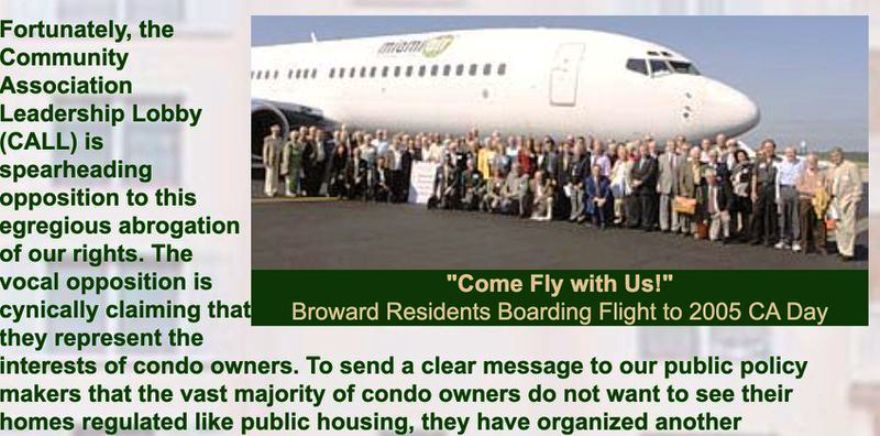 |
The Community
Association Leadership Lobby, or CALL, is a lobbying wing of
the Becker firm. The firm has on occasion brought a crowd of
condo dwellers to the Florida Capitol to talk to legislators
about condo laws. (regencytower.net/Website)
Prompted by the firm, retirees have asked legislators for
mercy from new laws that might increase condo fees, like a
requirement to add fire sprinklers. Former legislators said
condo residents didn’t necessarily know what the legislation
was about — just that it might cost them something.
“Their philosophy has been more of a ‘no mandates; allow
these associations to make their own decisions,’ " said
Travis Moore, a former Becker attorney and now head of the
Community Associations Institute, an association-industry
lobbying group. “And in some regards, that has fit in really
nicely with an administration and a Legislature that feels
that way about virtually everything.”
When the Champlain fell, it needed millions of dollars of
work, but hadn’t saved up the money. That’s because Florida
condos today can leave reserve funds empty with a majority
vote of owners present at a meeting. Fort Lauderdale’s Jim
Scott, a Republican senator, pushed the bill that reduced
the vote needed from two-thirds to a majority in 1980,
archived state records show.
Subsequent legislative efforts to make it harder for condos
to waive reserve requirements, or to require more money to
be saved in reserve accounts, failed.
As dust from the rubble of Surfside still hung in the air,
Becker’s chief condo lobbyist,
Donna DiMaggio Berger, appeared on national TV,
suggesting condos like the Champlain should have built up
stronger reserves.
“In far too many communities,” she told CNN’s Chris Cuomo,
“we do have members voting to waive reserves each year.”
Yet the Becker lobbying arm founded by Berger - the
Community Association Leadership Lobby (CALL) - fought
reforms aimed at making reserve funding mandatory, former
state Sen. Steve Geller said.
“Becker & Poliakoff opposed it. They organized their condos
against it,” said Geller, now Broward County mayor.
“Probably because that’s what their condos wanted them to
do. … They were not the only one, but Becker was the
biggest.”
‘Until the towering inferno occurs’
When the Legislature thought it was a good idea for condos
to install fire sprinklers, Becker sought to neuter the law.
It passed 21 years ago, but thanks in part to Becker, the
law still doesn’t apply to older condos like the ones lining
South Florida’s coast.
Becker unleashed a torrent of opposition.
“A prominent law firm located in Broward that does a lot of
condominium work, they organized a bus of condo leaders and
sent tens of thousands of letters to the Legislature saying,
‘Don’t do it, it’s too expensive to retrofit,’” Geller said
in a recent condo safety hearing. “So we moved it back three
or four years — until the towering inferno occurs.”
The firm found powerful allies in Broward’s Republican
legislators and one of them, Fort Lauderdale’s Ellyn
Bogdanoff, now works for Becker as a lawyer-lobbyist.
Donna Berger and Bogdanoff have bragged in online postings
and press releases celebrating their “win for condo
associations.” Their most recent victory came in 2019, when
Florida passed legislation delaying sprinkler compliance
until 2024.
Fort Lauderdale Republican Rep. George Moraitis, who
sponsored one of the delay bills, said tower fires are rare
and adding sprinklers expensive. He said Becker had earned
its influence in Tallahassee, and had “certainly financially
supported me and others.”
“They have a big influence. I think it’s an appropriate
influence. I think they’ve earned their place,” he said.
Is it safe?
Led by Berger, the Becker condo lobby also stepped into
battle against a bill that would have required, among other
things, structural inspections for condos every five years.
The bill, proposed by then-Sen. Rene Garcia, now a
Miami-Dade County commissioner, contained a litany of things
the firm opposed, including term limits for condo board
members, and a law making it illegal for condo boards to
“abuse” unit owners.
Berger told the Sun Sentinel at the time, in
2006, that the bill was so “provocative” it would only anger
people.
The bill said: “Every 5 years the board of administration
shall have the condominium buildings inspected by a
professional engineer or professional architect registered
in the state for the purpose of determining that the
building is structurally and electrically safe.” It failed.
Former Rep. Robaina wrung his hands in late June, when the
Champlain collapsed in Surfside, wondering if his failed
proposals would have saved 98 lives.
He told the Sun Sentinel that Becker’s firm stymied his
efforts to pass a bill requiring coastal condo safety
certifications every 10 years. Currently Broward and
Miami-Dade counties require inspections 40 years after
construction, and every 10 years thereafter.
“That bill never even moved, there was no support from the
House, and it wasn’t just Becker & Poliakoff, but other law
firms, saying there was an undue burden financially on the
associations,” Robaina said.
Pete Dunbar, an influential longtime lobbyist for the
Florida Bar and an adjunct professor at Florida State
University College of Law, said the Becker firm is by no
means alone in advancing condo issues, but is a respected
member of the condo “gaggle’' in the state Capitol.
“My experience is they have always been a respected voice in
this dialogue. I don’t know that anybody is overriding in
their influence,” he said. “It takes reaching consensus
among those respected voices.”
When Robaina in 2008 proposed that condos be inspected every
five years so that reserve funds could be properly
estimated, Becker took credit for nullifying the law.
Becker’s main condo lobbyist at the time, Yeline Goin, got
the bill amended so that condos could opt out, the
Sun Sentinel reported at the time.
The entire requirement was repealed two years later.
“That was done by the law firm of Becker & Poliakoff, I’m
sure, because they were the ones that lobbied against
everything I ever did,” Robaina told the Sun Sentinel
recently.
Robaina suspects the firm will be active in the legislative
scramble triggered by the Surfside collapse.
The firm repeatedly declined to respond to questions asking
about its work to defeat legislation, its position on
pending reforms, and its battles against individual condo
owners.
“To say our community association practice is against safety
is a gross misrepresentation,” the firm’s chief marketing
officer, Doreen Fiorelli, said in an email.
A voice for other side
Condo associations were riding roughshod over unit owners
until a Florida condo ombudsman office was created. The
first ombudsman appointed said Donna Berger played a role in
his firing.
First, she had issues with the creation of the nation’s only
condo ombudsman.
The audio recording of a 2004 committee meeting captures
Berger telling legislators the bill should be rewritten so
that condo boards could use the ombudsman to pursue unit
owners - the reverse of its purpose.
“I’d like to see it be a two-way street,” she said. “I’d
like it to be a forum where boards can go also if they’re
having a problem with a particular unit owner.”
Florida’s first condo ombudsman, Dr. Virgil Rizzo, supported
many of the provisions that were anathema to Becker: term
limits on condo board members, mandatory safety inspections
of condo buildings, mandatory education for board members,
and a law to make it illegal for board members to abuse
condo owners, a 2006 Sun Sentinel story recounted. Becker
“strongly opposed” his appointment, the Sun Sentinel
reported, and CALL was “a constant critic of the ombudsman.”
“They are fighting every year against anything that could be
considered owner-friendly or help owners to really see
what’s going on,” said Jan Bergemann, founder of the
owner-friendly advocacy group Cyber Citizens For Justice.
Rizzo’s office was empowered to monitor problematic condo
elections — another reason it was at odds with the Becker
firm, said Val Lucier, the state’s first monitor.
“Most elections, we’d run into a law firm that didn’t do
right by the membership but tried to do right by the board,”
Lucier said. “A large percentage were Becker & Poliakoff’s
attorneys. I don’t want to disparage one law firm over
another, but it was the fact.”
Berger also accused Rizzo of “overstepping” his authority as
an ombudsman, Bergemann said. Rizzo constantly clashed with
state officials, insisting his office was independent.
When Berger requested records of the ombudsman’s election
monitoring, Rizzo was accused of not responding to it.
Berger filed suit.
Rizzo said he soon got a call with this message from
then-Gov. Jeb Bush’s office: “‘You got a problem. You’re in
court.”
Rizzo went on a cruise and when he came back, a
note taped on his condo door said he’d been fired.
‘Invented the field’
The firm’s founders, Alan Becker and Gary Poliakoff, weren’t
just good at playing the game of condo law — they wrote the
rules.
Becker served in the state Legislature from 1972 to 1978.
The following year, he and his University of Miami law
school buddy founded their firm and got to work rewriting
Florida’s condo act.
In Tallahassee, Becker was the maestro of rewrites.
Poliakoff gave him real-world intelligence from Miami.
“They invented the field,” said Keith Poliakoff, son of Gary
Poliakoff and an attorney who worked at the firm until 2013.
Gary Poliakoff died in 2014, Becker in 2020.
Now the firm’s lawyers loom large in Florida’s lobbying
industry with a reach that covers every level of government,
from tiny municipalities to Congress.
Since 2017, Becker lobbyists appeared at least 560 times in
the Florida House of Representatives alone, the Sun Sentinel
found. Between the state and federal levels, their clients
include Miami-Dade and Palm Beach counties, the Broward
Sheriff’s Office, and 21 cities, towns and villages in
Florida, including Miami, Hollywood, and Pompano Beach.
“They became like the grandfather of community association
law all over the planet,” said Moore, of the Community
Associations Institute. “Every law firm that works in that
field, there’s someone you can trace back to [Becker].”
Commissioner-lobbyist Gongora
The experience of Gongora, the agent of record for the
Champlain when the towers collapsed, highlights the dense
web of connections between the firm and officialdom.
Gongora is a Miami Beach elected official and has been at
the center of at least 12 complaints, investigations and
inquiries lodged with the Miami-Dade Ethics Commission,
often dealing with his and Becker’s ability to sway city
politics through lobbying and representing clients. The
ethics commission only made two adverse findings against
Gongora: that he failed to file his financial disclosures on
time in 2018, and that he leveraged his office to secure
tickets to the 80s rock band New Order last year.
Gongora did not respond to multiple requests for comment.
The Sun-Sentinel identified at least 10 condominium
buildings connected to Becker that have appeared in front of
the Miami Beach special master - who rules on building code
violations - during Gongora’s tenure as a city commissioner.
During that time, Gongora made moves suggesting that he
wanted to replace the chief special master.
In 2010, the Miami-Dade ethics commission spoke with
then-Miami Beach city attorney Jose Smith about whether
Gongora had a conflict of interest in voting to nominate the
next special master.
“Commissioner Gongora is an attorney with Becker Poliakoff,
a firm which regularly appears before the Special Master.
Commissioner Gongora has let it be known that he believes
the current special master is too tough on violators and
should not be retained,”
according to a memo submitted by then-Executive Director of
the Miami-Dade Ethics Commission Robert Meyers.
Shortly thereafter, Chief Special Master Mario Goderich was
replaced by Abraham Laeser, a criminal defense attorney and
former prosecutor.
Meyers concluded that Gongora did not have a conflict of
interest because Becker’s clients would not be the only ones
to benefit from more lenient enforcement.
Keeping dissenters quiet
In a 1985 news article that called Becker & Poliakoff “the
largest condominium law firm in the world,” Gary Poliakoff
said the firm’s work had shifted from fighting condo
developers to fighting “dissident unit owners.”
Records show the firm has pursued condo owners aggressively,
racking up tens of thousands in legal fees that dwarf the
value of the disputes in question. At one condo represented
by Becker, the Boca View in Boca Raton, the firm’s hard
style is clear.
Unit owner Edward Lepselter made the mistake of taking on
Becker and Boca View, suing his association over a burst
pipe that cost him $1,300.
After a judge ruled in Boca View’s favor, Becker attorneys
claimed Lepselter owed them almost $120,000 in attorney
fees. The judge set them at $32,000.
“It is abundantly clear that this case was exceedingly over
litigated,” then-County Judge Sandra Bosso-Pardo wrote in
her response to Becker’s fee request. “The amount claimed in
this case shocks the court” as “duplicative, unreasonable,
unnecessary and excessive.”
In 2014, Lepselter declared bankruptcy. In a 2015 letter to
Judge Bosso-Pardo, Lepselter’s wife said Becker attorneys
were attempting to force them to sell their homesteaded
apartment and garnish part of the proceeds in order to pay
for the attorneys’ fees. Lepselter finished paying the fees
in 2019.
Another Boca View owner wound up owing Becker more than
$50,000 in legal fees after the association sued her for
violating its pet ban in 2010.
When Victoria Kowalewski bought her apartment in 2008, Boca
View allowed pets. But the association banned pets six days
before she moved in with her two dogs, a Brussels griffon
named Bella and a lab-beagle mix named Tuesday.
Kowaleski lost and was ordered to pay $51,037 in legal fees.
She moved out and filed for bankruptcy in 2012.
Another resident, Eileen Breitkreutz, sued the association
after she said they didn’t let her see financial records.
She told the Sun Sentinel that Becker “has rung up about
$222,000 in legal fees” she feared she’d owe — roughly the
value of her condo. She lost lost the case, but attorneys’
fees have yet to be officially submitted..
In fall 2015, the association with Becker’s backing sued
another resident, Laurenco Oliveira Faria, because he
complained to his state senator that a Becker attorney had
threatened him.
The association argued that Faria had agreed that mediation
of his complaint over key fobs was confidential. But on the
same day he agreed to settle the claim, he wrote to state
Sen. Maria Sachs with complaints about Becker’s tactics
during the mediation.
Faria complained that Becker attorney Robert Rubin said the
firm would wear him down and would never let him win. He
said one of Faria’s neighbors already owed $140,000 in legal
fees.
The mediator advised Faria that without an attorney, he’d
never “survive the Becker and Poliakoff tidal wave.”
Becker filed suit on behalf of the association, alleging
that Faria’s letter to his senator was a breach of mediation
confidentiality.
Faria didn’t give in. Eventually, he won $4,661 in legal
fees. But pursuing that victory in court, he said, cost him
$80,000.