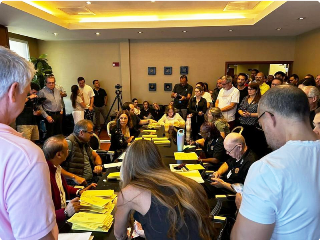
José Rincones sat on a crowded couch in his Brickell condominium’s wine and cigar room, a space where a November breeze swept in from the balcony to cool the hundred or so owners who gathered that Saturday. Rincones was one of many who had flown in from out of town — his a 1,600-mile journey from Venezuela — for this event.
|
Condo owners gathered Saturday at 9 a.m. to cast ballots and vote in new board members after many raised concerns over decisions taken by the association’s president as of 2022. |
By 2 p.m., condo owner and resident
Dorinda Spahr was voted in with 192 votes — with 115 votes
being the minimum needed — as the president elect. Pablo
Lignarolo and David Treiger were also voted in as part of
the three-member board. Kassell received zero votes.
“We won the election, but we still need ownership,” Spahr
said to owners at the end of the election, urging for owner
participation in meetings and votes in the months ahead.
The first task for Spahr and her fellow board members would
be the $21 million special assessment. Kassell failed to
hold a vote to approve the multi-million dollar special
assessment for the 16-year-old building in November. While
large budgets are permissible under state law, boards must
get 50% of owner approval for any project over $50,000 or
“exceeding 115% of assessments for the preceding calendar
year,” according to state statute.
A vote was never held.
Instead, residents got hit with assessments ranging about
$40,000 to $50,000, depending on the size of the residence.
Kassell set a deadline for January for a quarter of each
owner’s assessment with the rest paid over nine quarterly
payments.
“This mock election will be thrown out come Monday,” Kassell
told the Miami Herald. He declined to answer any questions,
citing the association’s law firm and representative Halpern
Rodriguez.
Marc Halpern, a senior and founding partner of the Coral
Gables-based Halpern Rodriguez law firm, did not respond to
an immediate request for comment.
Financial pressures after Surfside collapse
The election at 1060 Brickell follows a series of owners
pushing back at associations raising monthly condo
assessment fees, requesting special assessments and setting
expectations for reserve contributions come January.
The financial hikes come after the collapse of the Champlain
Towers South, which killed 98 residents in the summer of
2021. The building collapsed after owners had delayed
structural repairs and a $15 million special assessment for
the 39-year-old building at the time of the disaster.
In an attempt to safeguard the lives of condo owners and
residents in the future, the state established new laws
forcing owners to address structural issues and build
reserves for renovations and projects in the future.
The problem is the process, not the price of the special
assessment, said Diego Navia, a resident at 1060 Brickell.
More accountability and guardrails need to be established,
Navia said, for board members.
“There needs to be more timely enforcement,” he said. “The
laws passed were a great step forward.”
Over the next few days, the newly elected board plans to
fight for recognition from Kassell and clarity behind the
$21 million demanded special assessment. Spahr said they
just needed time to plan.
“We understand owners want answers. This was the first step
today. This was the most important step today The rest of
it,” Spahr said, “is a little unknown territory.”