|
Article Courtesy of The Daytona
Beach News-Journal
By Frank Fernandez
Published February 15, 2016
It is a neighborhood quarrel unlike any other, pitting some pilots’ love of
flying against some of their Spruce Creek Fly-In neighbors whose allegiance is
rooted in the ground.
Melvin Stanley, a pilot and homeowner at the plane-centric community with a
private runway, has filed a lawsuit against the Spruce Creek Property Owners
Association to force it to do what the suit claims its obligated to do: trim and
cut trees that create a hazard for pilots flying in and out of the community.
Stanley and his lawsuit said the trees
have grown dangerously tall near the end of the Runway 5. But
the association has voted against going Paul Bunyan on the oaks
and pines even though the timber triggered the FAA to strip the
airport of its night GPS approach.
“There are folk who are more interested in a tree farm than they
are an airport,” Stanley said in an interview.
The conflict over the trees has created turbulence in the
exclusive gated community built around a 4,000-foot runway with
expansive homes, featuring garages for cars and hangars for
planes. Aircraft roll along taxiways behind the houses fronting
on roads named after airplanes makers and pioneering aviators.
Celebrities have alighted at the community, including John
Travolta who lived there from 1989 to 1994 before flying off to
an air park near Ocala. |
|
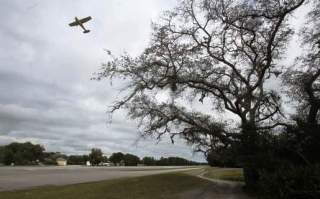
A
plane gains altitude during takeoff as it passes some of the trees that
have become a Spruce Creek Fly-In controversy.
|
Jim Calhoun is a a retired airline pilot and one of the board members that voted
4-3 in December against cutting the trees. He said he was speaking as a resident
and not a board member for this interview.
“I would like to preserve the environment,” Calhoun said in a phone interview.
“We’ve got some 150-year-old oak trees that it would really be sad to see
destroyed and my approach is that if there’s way to satisfy the FAA without
destroying those trees, I would prefer those methods."
Calhoun, who flies an RV-4 a small aerobatic prop plane, admits that the FAA
took away the airport's night GPS approach due to the trees.
“They said there were trees that were intruding into the 20 to 1 approach which
affected night landings only,” Calhoun said.
The approach refers to an "imaginary surface" which drops one foot for every 20
feet a plane flies. But while the surface is imaginary, the trees are quite
real.
Many airports have lost night GPS approach, Calhoun said, and one option to
solve the problem would be to put lights on the trees so pilots can see them at
night. Another could be to use the visual guide slope indicator, lights on the
ground which tell pilots whether they are too high or too low as they come in
for a landing, Calhoun said.
FAA spokeswoman Kathleen Bergen in an email confirmed that the trees were in the
way of a night GPS instrument approach, which the FAA prohibited at the airport
four to five years ago, she said.
“Pilots cannot fly the procedure at night because trees penetrate the approach
visibility surface,” Bergen wrote in the email.
Numerous trees, powerlines and houses exist at both ends of the runway.
Obstructions such as buildings or power lines would have to be lit, Bergen
wrote.
But lighting is not an option for the trees. The trees would have to be trimmed
or cut down, she wrote.
Another board member, Shane McLaughlin, who has flown planes since he was a
teenager and is an attorney licensed to practice in New Hamphire, said he has
voted three times to cut down the trees only to be on the losing side each time.
He said the community could be sued if someone crashes into a tree in the clear
zone.
“We are likely to have significant exposure not only for a legal standpoint but
from a moral standpoint because we could have trimmed the trees,” McLaughlin
said.
Stanley, who is represented by attorney Daniel Webster, provided a list he said
shows 37 trees that encroach into the approach clear zone to one end of the
runway. And a handful of those trees grow into the clear zone by
Jack-and-the-Beanstalk-proportions: 41-feet into the clear zone, 36-feet,
32-feet. Stanley said many are pines and oaks, including four historic oaks. But
he said making the historic trees history is not a problem since permits are in
hand to take them down.
Stanley’s lawsuit states that the Spruce Creek Property Owners Association is
required to maintain the airport so that there is no limit on its use. Any
change to that requirement would necessitate a 90 percent vote by the members of
the association based on its articles of incorporation. The “clearways” and
“clear zones” are part of the airport, the lawsuit states. The association
responded in court papers that it is only required to "maintain" the airport and
not impose limits on its use.
The lawsuit states that the association airport committee in September 2014
recommended not pursuing the night GPS approach because trimming and cutting the
trees was estimated at $42,000 to $62,000, not including mitigation. Spruce
Creek Fly-In's annual budget is about $2.2 million, the suit states.
Stanley said he can’t fly his twin-engine Cessna Citation jet into the airport
at night if there is any cloud cover because he can't use GPS. Stanley, a
retired tooling manufacturer, flies military veterans for a charity and also
flies for personal travel. He said the airport and its night approach were
factors in his decision to buy a home in the community in 2006.
Stanley said the trees also pose a hazard if pilots try to use a system of
airport navigation lights to land. The trees are a particular hazard for
nonresident pilots visiting the airport unaware of the hazard, he said.
“If you are flying in between the lights and you got a damn tree sticking up at
30 feet and its dark and green what do you think is going to happen if you get
lined up with that tree?” Stanley said.
Stanley said the association's proposal to cut a 200-foot swath through the
trees is not enough because it would require flying planes that can be
70-feet-wide in a narrow path in sometimes windy conditions.
"Some of the pilots started referring to it as the corridor of death," Stanley
said. |