|
Article Courtesy of ABC
Action News Tampa WFTS
By
Adam Walser
Published July 20, 2024
|
WATCH VIDEO |
|
SARASOTA — We’ve told you about the new state law that prevents homeowners’
associations from banning pickup trucks and work trucks from parking in
driveways.
It took effect July 1, and already, one Sarasota HOA is saying it will continue
to hand out fines and tow vehicles under its existing regulations.
The I-Team is breaking down why the association is still enforcing parking rules
despite the new law.
“You can imagine how ecstatic I was”
|
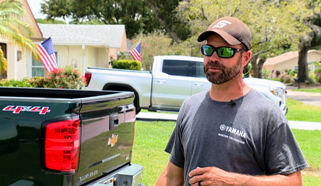
Ryan McIntire, who goes by “Mac,” loves
his 2014 Chevy Silverado pickup.
“It’s functional hauling things most of all,” McIntire said.
“Also, there’s the extended cab. I do have a wife and
daughter.”
But his truck doesn’t easily fit into his garage.
“I cannot park my own truck in my own driveway,” he said.
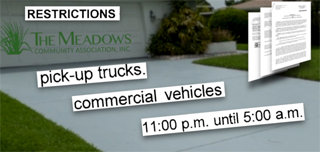
McIntire’s subdivision, The Meadows, doesn’t allow pickup
trucks or commercial vehicles in their driveways between 11
p.m. and 5 a.m.
That’s based on rules written in 1976 before Jimmy Carter
first took office.
Violators caught by the association’s nightly safety patrol
face warning letters and fines and can be towed out of their
driveways.
McIntire agreed to the rules when he
moved into the neighborhood in 2019, but he hoped a new law
would change that.
|
|
Residents of The Meadows in Sarasota are not allowed
to park pickup trucks or commercial vehicles in their driveway
between 11 p.m. and 6 a.m.
|
“You can imagine how ecstatic I was when I heard I can park it at my own house,”
McIntire said.
“Everybody’s paying to park in here”
McIntire and his wife now make twice-daily trips to drop off and pick up his
truck at a fenced-in lot eight-tenths of a mile from his home.
|
He and his neighbors pay $500 per vehicle
per year to park there.
“We all know each other. We see each other every night and
every morning,” McIntire said.
“If you come back at night, it’s full. Everybody's paying to
park in here,” neighbor Melissa Siet said.
She lives on the opposite side of the 1,600-acre
neighborhood.
“The schlepping, the back and forth. It’s hot,” Siet said.
She runs a mobile esthetics business out of her $200,000
custom Mercedes van.
“I've got my own power, water, everything,” Siet said.
|
|
The Meadows parking restrictions can include
citations, warning letters and towing
|
Her husband also parks a pickup in the lot.
“We’re ending up with more questions than answers”
Siet welcomed the new law, which says:
“Homeowners' association
documents, including declarations of covenants, articles of incorporation, or
bylaws, may not preclude... a property owner or a tenant, a guest, or an invitee
...from parking his or her personal vehicle, including a pickup truck, in the
property owner's driveway.”
“I thought it was for everybody. We got so excited about it when it got signed,
and we thought, great, this is going to save us $1,000 a year, but that’s not
happening,” Siet said.
Meadows residents received this email days before the law went into effect: “All
current parking rules and regulations will remain the same.”
“They got ahead of it and said, ‘no, no, no, no, no, no, no, no. We’re gonna
keep everything the same way.’ So we’re ending up with more questions than
answers at this point,” McIntire said.
Kaufman language
The general manager for the Meadows Community Association declined an on-camera
interview but said in an email that the application of the new law depends on
the governing language of the community association and the time it was
recorded.
The email referred to something called “Kaufman language.”
Some restrictions have what’s known as Kaufman language, which was sort of a
famous case.
Attorney Jonathan Ellis said some HOAs incorporate the language “as amended from
time to time” in their bylaws and other documents.
“That’s indicating if the legislature changes the statute, that would apply.
Most homeowners' associations don’t have that language,” Ellis said.
That includes The Meadows.
Both McIntire and Siet plan to abide by the existing rules.
“We don’t feel like we have a voice. We don’t know really what to do,” Siet
said.
But they hope someone will challenge them.
“It got the governor to sign it into law. So I cannot be the only one with this
concern,” McIntire said.
|