A report on the soundness of high-rise
residential buildings across Florida did not list any unsafe
condominium complexes in the Palm Beaches, but whether that
provides reassurance is debatable.
Palm Beach County had the highest rate of noncompliance
among South Florida building officials tasked with reporting
condominium safety inspection results to the state. The lack
of data has created what industry officials describe as a
significant void in understanding the true extent of
structural problems in local condo buildings.
"The report highlights a real data gap," said the Community
Associations Institute, a nonprofit organization that
represents HOAs and condominium associations. The
organization said Palm Beach County's reporting failures
make it difficult to determine the full extent of structural
issues locally and may be understating the number of
buildings with significant structural concerns.
The review is based on a collection of building inspection
reports mandated after the 2021 building collapse of
Champlain Towers South condominium in Sunrise that killed 98
people.
The study found that 17 of Palm Beach County's 39 municipal
building officials, or 44%, failed to submit required
milestone inspection reports for 2024 and 2025.
The study did not identify the officials who failed to
report, and their identity was not immediately available.
The law requires condominium buildings that are at least
three stories tall and meet certain age thresholds to
undergo milestone inspections and requires local building
officials to submit inspection data to the Florida
Department of Business and Professional Regulation.
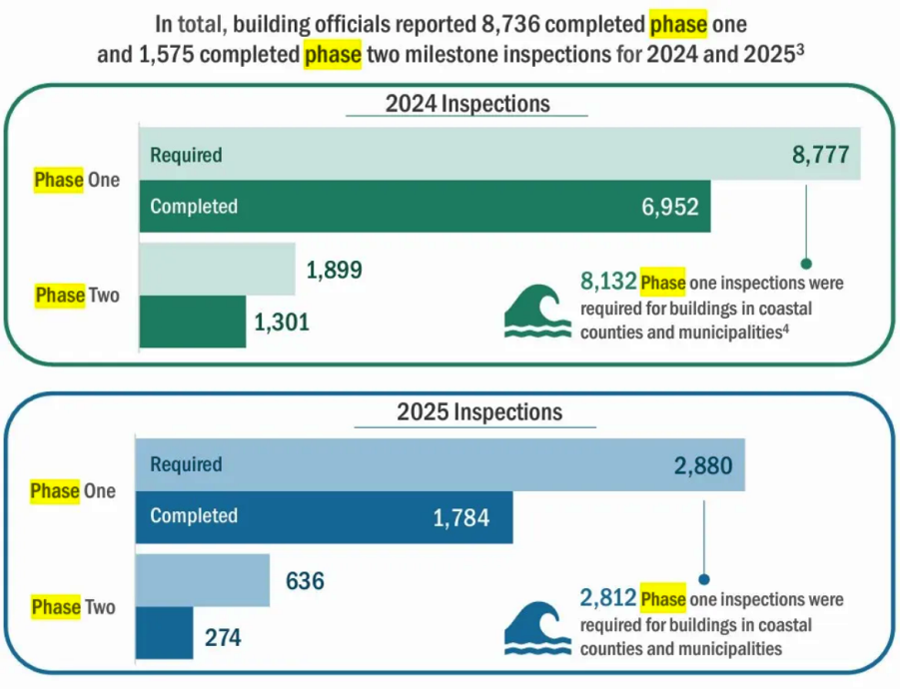 |
|
The graphic shows statewide numbers of condo buildings inspected under the state law to ensure their structural integrity. A Phase Two inspection indicates that inspectors found structural issues that needed to be addressed. (Office of Program Policy Analysis and Government Accountability) |
The findings were detailed in a
report compiled by the Office of Program Policy Analysis
and Government Accountability, the Florida Legislature's
nonpartisan research arm.
Milestone inspections occur in two phases.
Phase One is a visual inspection designed to determine
whether a more comprehensive Phase Two inspection is
necessary. During Phase Two, a licensed engineer or
architect must identify areas of substantial structural
deterioration and recommend repairs.
There are nearly 600 condo buildings consisting of
25,000 units in Palm Beach County that are covered by
the state law.
According to the state report, milestone inspections
statewide identified substantial structural
deterioration in 2,535 condominium and cooperative
buildings. Repairs were completed on 903 buildings, with
costs ranging from about $1,000 to $30 million.
A state map included in the report placed Palm Beach
County in a category showing between 10 and 41 buildings
that underwent Phase Two milestone inspections.
That means those structures had issues that warranted
repairs. Broward and Miami-Dade counties fell into a
much higher range, with between 155 and 308 such
inspections.
Missing reports leave uncertain how many local condos
have serious structural issues
However, because nearly half of Palm Beach County's
municipal building officials failed to report inspection
data, the actual number of those with structural issues
could be significantly higher.
A spokesperson for the county Building Division reported
Thursday, July 30, that 10 structures in the
unincorporated area of the county had still not
submitted Phase One reports.
In June of 2025, there were nearly 100 buildings that
had not submitted those reports. The county may soon
refer the 10 non-compliant buildings to the Code
Compliance Division to enforce the state law. The 10
structures include:
-
Olympus Village in Lake Worth, 2 buildings
-
Wellington, A-M
-
Sabal Lake West of Boca West
-
Pines of Boca Barwood, 3 buildings
-
Village Green Boca Raton, 3 buildings
The study found that structural
deterioration was concentrated primarily in coastal
communities, where saltwater exposure accelerates
corrosion of steel reinforcing bars embedded in
concrete. As rebar corrodes, it expands and weakens a
building's structural integrity.
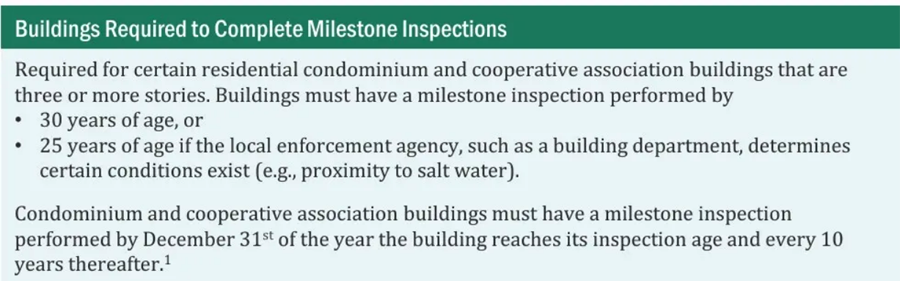 |
| Details on which types of residential buildings must be inspected under the state law designed to ensure their structural integrity. (Office of Program Policy Analysis and Governmental Accountability) |
The report also highlighted ongoing
uncertainty about what constitutes an "unsafe" building.
Building officials across Florida use different standards
when making that determination, and many buildings
identified as unsafe remained occupied.
Five condominium buildings were evacuated statewide,
including three in St. Lucie County. None of those were in
Palm Beach County.
One of those properties was Villa Del Sol, a beachfront
condominium complex at 11000 S. Ocean Drive on Hutchinson
Island, just north of the Jensen Beach Causeway in southern
St. Lucie County. Residents were ordered to leave after an
engineer conducting a milestone inspection discovered severe
concrete deterioration and rusted reinforcing steel.
Residents had roughly 30 minutes to gather belongings before
leaving their homes. The buildings remain under repair.
The financial impact of the new law has been substantial.
Condo associations across Florida have imposed special
assessments to pay for mandated repairs. Some of those
special assessments in Palm Beach County have exceeded
$100,000.
Some developers have sought to purchase aging buildings for
redevelopment. The average repair bill identified in the
report approached $500,000.
Thirty buildings faced repair costs exceeding $1 million,
with most of those properties located in Palm Beach, Broward
and Miami-Dade counties.
Greg Batista, a South Florida structural engineer who has
done scores of Phase Two inspections, said he was not
surprised by the findings of the report.
He noted that South Florida has a glut of older buildings
that were always in need of repair. The post-Surfside law,
he added, brings about a level of transparency that never
existed before.
Buyers now can know beforehand the condition of the building
they are buying into. "That helps to rekindle confidence in
the real estate market," he said.
But Batista said he was concerned about the level of
non-compliance cited in the report.
"There has to be better enforcement," he said.
Real estate lawyer Michael Gelfand said one of the reasons
why some of the municipal building officials did not file
reports with the state was because they did not have
buildings that required Phase One or Two inspections. The
report should have noted that, he said.
As for the law itself, Gelfand said it has done what it was
intended to do by making sure buyers know what they are
getting into when they buy a condo in a high rise. It has
also helped to ensure that necessary repairs are getting
done to prevent another tragedy from occurring.