Exterior deterioration
at the Addison Mizner-designed William Grey Warden House
condominium building might take up to a year to repair on
the near North End of Palm Beach.
But that work can only be done after the private
Preservation Foundation of Palm Beach and the town's
Landmark Preservation Commission sign off on a restoration
plan, Lisa Reves, attorney for the landmarked building’s
condominium board, told the Code Enforcement Board during
its most recent meeting.
|
At 200 N. Ocean Blvd., a landmarked building that houses six condominiums and was once a single-family mansion known as the William Gray Warden House is the subject of an ongoing code-enforcement case in Palm Beach. |
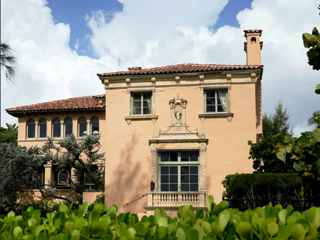
The Preservation Foundation is reviewing
contractors and the scope of work being proposed at the
oceanfront property to repair not just the crumbling
stonework at Unit No. 1 — the section of the property cited
by code officers — but also all of the stonework on the
building’s facade, Sunny told the board.
The individual condos are owned separately but the
homeowners association oversees the overall property.
The foundation’s approval is needed because of a
conservation easement between the Warden House's condo
association and the Preservation Foundation. That document
is tied to the Warden House’s designation in the National
Register of Historic Places.
Signed in 1987, the easement has served as an agreement
between the two parties and gives the foundation indefinite
rights as guardian of the building’s historical
architecture, Sunny said.
That means the Preservation Foundation has the right to
oversee all repairs of the Warden House’s exterior. Any
restoration project would require the foundation’s written
approval, she noted.
Reves said the Warden House has made progress in its
planning efforts, noting that the condo board had already
sought bids from engineering firms, cast-stone contractors
and conservation experts.
But Sunny noted that any contractors must be approved by the
Preservation Foundation, noting that the nonprofit
organization had already turned down one bid from one
stonemason company because the foundation “did not feel had
the expertise in preservation.”
Part of the issue is that stone contractors and engineers
often would rather replace cracked or damaged stonework
instead of repairing it, she told the board.
“Our first and foremost goal is always to preserve and
repair as much as possible, and not to replace,” Sunny said.
“Our goal is to see only the minimal amount of stone
replaced on this building, and to have anything that can be
repaired, be repaired by the experts.”
The condominium association has been working toward that
goal, but it’s a time-consuming challenge considering that
several companies are required for the project.
“Basically, you’re telling us there is no timetable,” board
member Chris Larmoyeux said.
While Sunny didn't give a timeframe for the work to be
completed, she said that she would “not be happy if by
September we do not have significant progress” toward
getting the landmarks commission's approval for the
restoration project.
Code board members questioned if the project should just
prioritize repairing the northeastern portion of the
building cited by code officers.
But code officer John Moriarty told the board that to come
into compliance, the condominium board would need to undergo
a final inspection from the Planning, Zoning and Building
department after it is repaired.
Considering the project’s scope, he said, construction
permits issued in the future would likely target work on all
the building’s facades
Moriarty told the board he saw no issue giving the
condominium board additional time.
“I think if the people are genuinely concerned about
preserving this historic building and maintaining it for the
safety and security of the residents, that they (should) do
the whole thing and do it properly,” Moriarty told the
board.